
Five ways to save our ocean, according to leading conservationists
EDITOR’S NOTE: Call to Earth is a CNN editorial series committed to reporting on the environmental challenges facing our planet, together with the solutions. Rolex’s Perpetual Planet Initiative has…
EDITOR’S NOTE: Call to Earth is a CNN editorial series committed to reporting on the environmental challenges facing our planet, together with the solutions. Rolex’s Perpetual Planet Initiative has partnered with CNN to drive awareness and education around key sustainability issues and to inspire positive action.
Sylvia Earle has many titles: oceanographer, marine biologist and “Her Deepness,” to name a few. Perhaps the most endearing and characteristic of them all: “Ocean Sister” — a nickname given by friend and marine conservation ally Titouan Bernicot.
Now 90, Earle has explored the ocean and advocated for its protection for more than seven decades — from cataloging aquatic plants to pioneering deep-sea research.
A trailblazer in her field, in 1979 she set a record for the deepest walk on the ocean floor in an untethered diving suit, and in 1990, she became the first female chief scientist of the NOAA (the US National Oceanic and Atmospheric Administration).
In 2009, she founded Mission Blue, a nonprofit that protects the ocean by establishing Hope Spots — marine areas recognized for their ecological importance and championed by local communities — and empowering conservation through education.
That vision has inspired and shaped the next generation of ocean advocates — including Bernicot. After witnessing the decline of the reef off his home in Mo’orea, French Polynesia, he made it his life’s mission to help restore the world’s coral reefs.
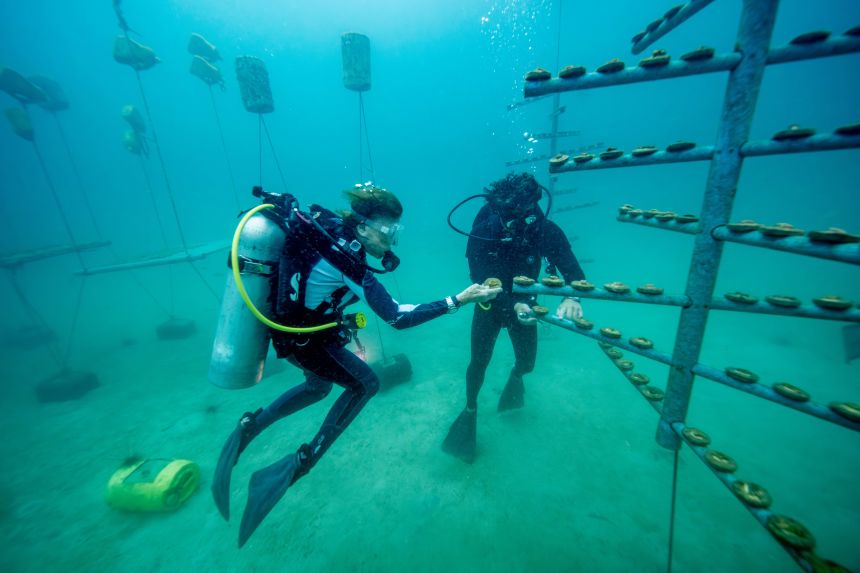
He founded Coral Gardeners in 2017, and what started as a local coral-planting effort has turned into an international movement. Today, the organization has planted more than 221,000 corals across 25,100 square meters (30,019 square yards) of reef and is working toward a presence in 10 countries by 2030.
Now, the two Rolex Testimonees are joining forces in the fight to save our ocean. In March, they dove together in Thailand, where Coral Gardners’ latest outpost is helping restore bleached reefs around the remote Koh Mak and Koh Kood islands, which Earle believes could become a Hope Spot.
The pair recently sat down together with CNN inside National Geographic’s new Museum of Exploration to discuss the state of the ocean, how technology can help it recover and why exploring and protecting marine ecosystems is important for all life on Earth.
These are five ways they believe we can turn the tide and revive our ocean.
1. Turn setbacks into opportunities
With scientists anticipating a powerful Super El Niño climate pattern this year, which could significantly increase ocean temperatures and put even more stress on coral reefs, Bernicot admits he’s worried about what lies ahead.
But instead of bracing for disaster, he said Coral Gardeners is using the event to test climate adaptation strategies. By experimenting with more heat-tolerant corals, he hopes today’s challenges will help build more resilient reefs for the future and advance restoration efforts worldwide.
“It’s an opportunity in a way to try to improve the scientific methodology, and I think that’s the only way,” he told Earle.
2. Support local efforts
Mission Blue and Coral Gardeners, supported by the Perpetual Planet Initiative, are built around the same idea: lasting conservation begins with the people who know an ecosystem best.
When Earle founded Mission Blue, the goal was to inspire people to protect the places they love. Today, the organization supports more than 170 Hope Spots across 116 countries. Earle called it “a network of hope” led by “Champions” — who are local scientists, conservationists or community leaders at the forefront of protecting their marine environment.
“Champions want to do whatever they can, either to bring back health, or to find a place that is still in great shape and say, ‘this needs to stay this way,’ and we need to protect those areas,” Earle said.
Bernicot also believes this global issue requires local expertise. As Coral Gardners expands into other countries like Fiji and Thailand, it partners with, hires and trains locals to manage the nurseries and outplant corals.
3. Create opportunities for participation
When Bernicot first began planting coral, he said officials wouldn’t grant him permits. But he did it anyway: “I was like, ‘put me in jail, I don’t care. I’m just a kid trying to save what I love,” he recounted to Earle.
So when he received an unexpected call from French Polynesian President Moetai Brotherson a few months ago, he was nervous. But the president thanked him for ignoring the rules and announced the country would officially recognize coral gardener as a profession, complete with a legal framework, training academy and diploma, said Bernicot.
And Bernicot is already thinking of other ways to get people involved.
“The last nine years, people were watching us restore the reef, plant corals,” he said, “The next nine years, people will participate — everyone with hands can be a gardener.”
They are aiming to make kits that can be deployed all over the world wherever there’s a reef in need, Bernicot explained.
“Imagine if, through global collaboration with Hope Spots, with what you’re doing with Coral Gardeners, we could inspire caring and making it cool to care, give people jobs to care, to make it fashionable, to make it normal to care for the ocean,” Earle said to Bernicot.
4. Leverage technology
Coral restoration is no longer just divers planting coral by hand. Coral Gardeners has brought together engineers from Tesla and SpaceX alongside scientists from Berkeley, MIT and Stanford to develop new tools to make coral restoration faster, smarter and more scalable.
From using AI to monitor reef health and track fish populations to building climate-resilient corals, CG Labs — the organization’s innovation and research arm — is helping transform restoration into a data-driven science.
According to Bernicot, just 13 months after restoring reefs through breeding and planting tens of thousands of heat-resistant “super corals” in Mo’orea, the team recorded twice as many fish as before.
Earle, too, is no stranger to leveraging technology. She has been advancing ocean exploration through DOER Marine, where she has helped develop advanced submersibles and underwater technologies that expand scientific access to the deep sea.
“This is going to open a new window that we can share with the world and inspire our kids and anybody to want to see and take care of this amazing planet, this blue speck in the universe that is our only home,” Earle told Bernicot.
5. Protect entire ecosystems — not just coral
Healthy reefs depend on far more than coral alone. Earle said that fish, algae, seagrass, mangroves and countless species all play a role in keeping reefs alive.
It’s a lesson Bernicot says transformed his thinking: “We are not trying to restore corals, we are restoring the entire ecosystem.”
These marine ecosystems can’t be viewed in isolation, either, Earle said: “Connecting coral reefs with Antarctica, with the Arctic … it all ties together.” Protecting one habitat ultimately means protecting them all.
That ecosystem-first approach is already shaping conservation efforts in French Polynesia, a global trailblazer in ocean conservation, where there are protections in place for more than 30% of its ocean. Just this June, it announced two new Marine Protected Areas equal to the size of France.
Hope for the ocean
Earle and Bernicot acknowledge the ocean faces enormous challenges but they recognize that raising awareness plays a massive role in protecting it. “People don’t know why they should really care about the ocean,” Earle said. “The ocean is so big, so vast — until they know that the ocean keeps all of us alive, why would you care?”
“We have a built-in life-support system called nature, mostly ocean — 97% of where the water is — and no water, no life; no blue, no green,” she said.
“It is about protecting reefs, it is about protecting whales, it’s about protecting the ocean,” Earle added. “But that means it’s about protecting us.”
Some information for this report was gathered via edition.cnn.com.
Community Credibility Vote
Help the community assess this article's credibility. Your vote is weighted by your trust score.
Related Articles
Sponsored
Sponsored