
2,300 years in the making, a record-setting bridge is finally in the works. Because of Trump. Sort of
Around 250 BCE, the Romans laid wooden decks across floating barrels to span the Strait of Messina. In a victory march across the makeshift bridge, the soldiers transported 140 Carthaginian elephants…
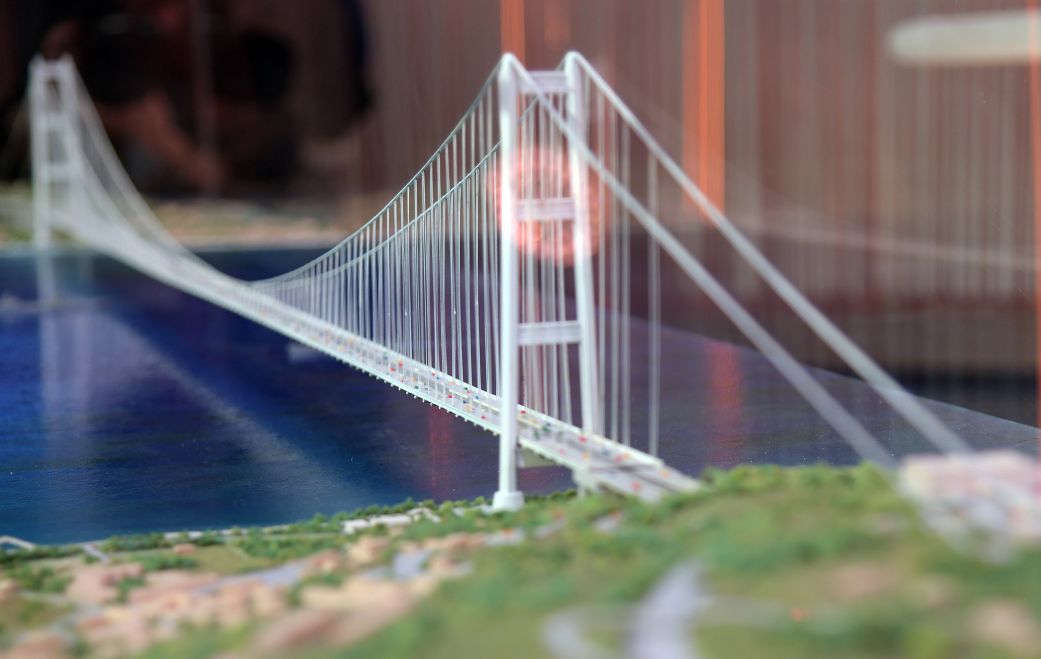
Around 250 BCE, the Romans laid wooden decks across floating barrels to span the Strait of Messina. In a victory march across the makeshift bridge, the soldiers transported 140 Carthaginian elephants from Sicily to Rome’s Circus Maximus, according to the first-century historian Pliny the Elder.
Since then, many business and political leaders have tried and failed to build another bridge there.
Until now. Supported by Prime Minister Giorgia Meloni, the Italian government in August 2025 gave final approval to span the 2.3-mile channel. If completed (it faces some legal challenges), it would become the world’s longest single-span suspension bridge.
But Meloni’s bridge isn’t just a public works project. She declared the infrastructure investment critical to Italy’s national defense. It’s a clever, if comical, maneuver to help Italy meet onerous military spending targets pushed by President Donald Trump and enforced by NATO.
Europe’s spending problem
Those defense spending targets, requiring European countries to invest the equivalent of 5% of their gross domestic product in their militaries by 2035 (up from today’s 2%), have threatened to upend already painfully tight budgets and exacerbate the region’s enormous fiscal and economic challenges. That presents Europe with a tough choice between its defense and its social welfare programs.
A long bridge won’t solve the problem. But it’s emblematic of the hurdles Europe faces as it works to become militarily independent from the United States – whose protection freed up €1.8 trillion in European social welfare spending since 1991, according to Germany’s Ifo Institute.
Most European countries, with the current exception of Germany, are in an extraordinarily tight fiscal position, stymied by governments’ massive spending to contend with the pandemic, quickly followed by high interest rates to fight the ensuing inflation shock.
European economies took the dual shocks much harder than the United States, which was insulated by a more diversified economy and a recent world-leading AI buildout.
To deal with surging debt loads, many European countries raised taxes and cut social welfare spending. That led to political upheaval in several nations, including the United Kingdom and France. Over the past seven years, France has had seven prime ministers, and the UK is about to get its sixth.
That’s not exactly the best environment to start increasing military spending by “literally billions of dollars,” as NATO Secretary General Mark Rutte announced Tuesday. But that’s what Trump and NATO are demanding Europe to do.
Taking his tanks and going home
Trump is forcing the issue: Constantly fed up with NATO members’ lack of effort to meet their defense spending targets, Trump has privately and publicly mused about drastically drawing down America’s military presence in Europe. That began in May, when the Pentagon announced it was withdrawing 5,000 troops from Germany.
Germany, with its robust manufacturing economy, ramped up its defense spending with a clear path to reaching the 5% target. Several eastern European countries, including Russian neighbors Poland, Lithuania and Estonia, have made significant progress toward the goal.
Other nations are struggling. The UK said it would increase its spending by making budget cuts elsewhere – but much of that spending remains unfunded. France’s parliament similarly passed a €436 billion defense spending plan last week with an insufficient budget to fund it. Italy has openly questioned if it can get there. Some European countries like Spain have openly defied the bloc, saying they won’t meet the new military spending targets.
Many countries, already facing political storms and serious fiscal problems, will struggle to meaningfully cut their welfare systems or change their spending models, said Andrew Kenningham, chief Europe economist at Capital Economics.
France’s debt, for example, would explode to 150% of its GDP by 2035 if it met NATO’s defense spending targets, up from 135% at current spending levels, according to Kenningham.
“The assumption is there will be a massive increase in defense spending, but I’m skeptical it will happen,” said Kenningham. “Few feel strongly committed to taking on the burden from the US.”
Uncertain economic benefit
Proponents of increased European defense spending argue that it’s necessary and could unleash an economic boom in the region.
“If the increased defense budget is spent wisely, it could bolster long-run productivity and economic growth,” said Ethan Ilzetzki, professor at the London School of Economics. “But it isn’t a wholesale solution to all of Europe’s ills.”
Europe faces a challenge the United States doesn’t: Rather than pooling resources for one federal government, European countries each have their own political leaders with their own budgets and economic considerations to contend with. That means those nations will all need to buy the same equipment, exacerbating a procurement problem: Europe is heavily reliant on foreign imports for defense.
That’s part of the reason why the economic benefits of increased defense spending may be muted.
Research and development accounts for an average of just 4% of European countries’ defense budgets, compared to 10% for the United States – which reaps significant economic multiplier effects from that military spending.
Europe also faces an industrial capacity problem, with low unemployment and 200,000 new skilled workers needed to keep pace with increased military demand, the Milken Institute estimates.
So, the only way through is a painful one, said Ilzetzki. European countries will have to institute more fiscal reforms, reconsidering their tax and spending – including defense.
“Framing the question as ‘how will we fund increased defense spending?’ is unwise and leads to a scramble to find piecemeal and usually inefficient fiscal measures to fill the gap,” noted Ilzetzki.
That’s how you end up with a gigantic bridge that’s classified as a military project.
Some information for this report was gathered via edition.cnn.com.
Community Credibility Vote
Help the community assess this article's credibility. Your vote is weighted by your trust score.
Related Articles
Sponsored
Sponsored