
They Thought There Was No Immediate Danger. Then a Massive Wall of Smoke Arrived
At first, all Miiyah Paavola could visibly see was a thick, impenetrable wall of gray smoke. From her quiet home in Namaygoosisagagun First Nation, located in northwestern Ontario, the billowing smoke…
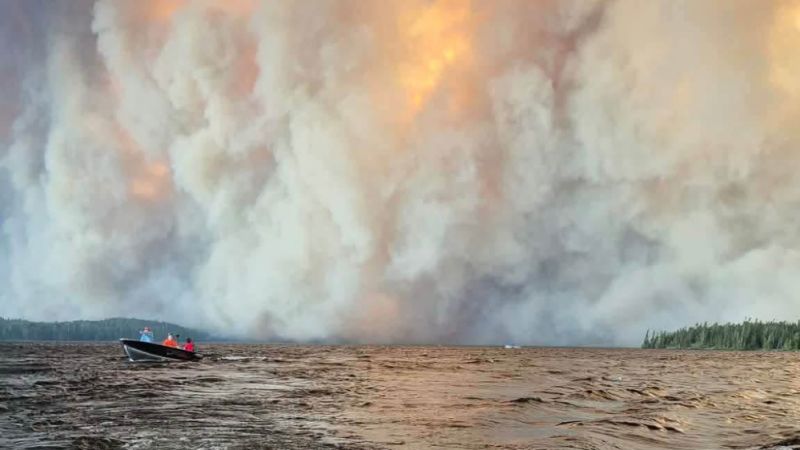
At first, all Miiyah Paavola could visibly see was a thick, impenetrable wall of gray smoke.
From her quiet home in Namaygoosisagagun First Nation, located in northwestern Ontario, the billowing smoke appeared dangerously close.
But the highly remote Indigenous community states that on that fateful Monday, July 13, they were formally told by the provincial Ministry of Natural Resources that there was absolutely no immediate danger.
Within a mere few hours, they were desperately fleeing for their lives.
“It was all incredibly fast-paced. There was not really much time at all to stop and think about exactly what was happening,” Paavola recently told CNN.
She quickly grabbed a soaking wet towel before tightly squeezing aboard a small, aging aluminum boat directly with five other terrified people, three dogs, and a cat. The deeply isolated community, also widely known as Collins First Nation, uniquely has absolutely no direct road access, heavily relying only on a single railway line and the waters of Collins Lake.
Paavola truly couldn’t fully grasp the immense scope of the danger until her small boat rapidly pulled away from the shore.
“All you could possibly see was bright orange and dark gray and it was incredibly dark,” she recalled. But as they desperately sailed away, she could finally see exactly just how incredibly close they’d actually been to the roaring fires. “When I was directly going across maybe about the second small island, that’s exactly when I watched it. I could just barely see the massive flames rapidly reach the shoreline. And it was a very thick, suffocating wall of smoke that followed it very quickly.”
“If we had waited absolutely any longer, we definitively would have been dead.”
Only roughly 25 of the community’s standard 60 members were actually physically in Collins when the roaring fire arrived. Shaken residents firmly say that fortunate fact likely saved numerous lives, as panicked people quickly crowded into aging 12- and 14-foot small aluminum boats typically powered by decades-old outboard motors. Heartbreakingly, many had to reluctantly leave their beloved pets behind.
The massive fires that entirely devastated Collins are just one part of a much wider, ongoing wildfire emergency rapidly unfolding across all of Canada, where a staggering 889 active fires were actively spreading as of late Thursday night, officially according to the Canadian Wildland Fire Information System. Of those, 163 highly active wildfires are specifically located in Ontario, according to the province’s official Ministry of Natural Resources.
‘All I could think was my children were gone’
Miiyah actively remembers the frantic escape itself genuinely being just as utterly terrifying as the fire.
“It was deeply scary,” she stated. “There were quite a few terrifying times I felt like we were definitely about to tip over.”
Their heavily loaded boat directly faced strong, choppy waves during the roughly 40 anxious minutes it ultimately took to sail directly from the northern edge to the safer southern part of Collins Lake. Shortly after rapidly leaving the burning shore, they violently struck a hidden rock and nearly flipped completely into the dark water.
Miiyah’s frightened mother, Chief Helen Paavola, actually wasn’t currently in the village when the massive fire initially broke out. She firmly stated a designated fire official had previously told her earlier that there was absolutely no immediate danger, heavily insisting the thick smoke concerned residents were seeing primarily came from a smoldering, distant fire farther away.
Chief Paavola deeply remembers the terrifying moments of absolute agony when she desperately couldn’t reach vulnerable members of the isolated community during the chaotic evacuation, notably including her own daughter and two sons.
“All I could possibly think was … they’re completely gone. My beloved children are gone. My entire community is gone,” she emotionally told CNN. “There are simply no adequate words to properly explain the profound relief that I physically felt when I finally knew absolutely everybody was out safe.”
But just exactly like all other modest houses in Collins First Nation, her own family home was completely and utterly destroyed by the raging fires.
At a serious press conference actively featuring Ontario Premier Doug Ford, various government officials publicly stated that the fierce fire had suddenly started unusually close to the small community in Collins, directly leaving incredibly little time to properly respond. The provincial government formally said that it would deeply review its overall emergency response to the dire situation.
A community turned to ash
The absolute destruction of Collins has unfortunately become one of the absolute starkest examples of the sheer devastation caused by this tragic week’s massive fires.
According to Linda Debassige, the respected Grand Council Chief of the Anishinabek Nation in Ontario, more than 30 family homes were completely lost, right along with the main administration office, the only school, the community center, crucial storage buildings, vehicles, and vital, essential community equipment.
“If they had simply waited for an official emergency response,” she grimly stated, “we would all certainly be on a dark recovery mission actively looking for the burned bodies of innocent children, elderly people, men, and women.”
The broad organization, which directly represents 39 distinct First Nations, notably including Collins, officially says it is currently heavily paying for temporary accommodation, daily meals, and essential supplies for the displaced evacuees staying in the nearby, larger city of Thunder Bay simply because promised government support has yet to actually arrive.
She firmly says Collins has unfortunately fallen through complex jurisdictional cracks primarily because it is officially considered a “near band,” a struggling community still actively working toward achieving full federal recognition, which severely complicates their direct access to necessary government support.
The small community had also been heavily threatened by a nearby wildfire only a few weeks earlier, she directly noted, but unfortunately, very little was practically done afterward to actively better protect it through strategic fire breaks or any other useful preventative measures.
Growing concerns over wildfire preparedness
The sudden destruction of Collins has rapidly renewed pressing questions about whether Ontario’s overall wildfire strategy is actually keeping adequate pace with increasingly intense, modern fire seasons.
Lise Vaugeois, the dedicated Member of Provincial Parliament specifically representing Thunder Bay-Superior North, directly says at least a full dozen small communities rapidly scattered across northwestern Ontario currently remain under strict evacuation or high-alert standby orders.
“This is honestly the very first time, in my entire knowledge, that established communities within a simple three-hour drive of Thunder Bay have forcibly had to be completely evacuated,” she recently told CNN.
She firmly said increasingly intense, massive fires are rapidly exposing highly dangerous gaps in official wildfire preparedness, directly pointing to the pressing need for significantly more firefighting resources, increased prescribed burns, and strategic fire breaks to physically reduce dry fuel long before fire season even starts.
“It’s somehow become weirdly acceptable that First Nations communities routinely get evacuated absolutely every single year,” she pointedly said. “It’s deeply traumatizing, and I’m absolutely sure the lasting effects will quietly be with these people for a very long time.”
Even larger communities located outside the immediate danger fire zone are physically feeling the heavy impact.
“Thunder Bay literally has gray ash falling down and the local air quality is currently quite bad,” Vaugeois noted.
The thick smoke has rapidly spread hundreds of miles far beyond northwestern Ontario, heavily affecting people located far from the actual fire line. Toronto, Canada’s absolute largest city, bleakly woke on Wednesday directly beneath hazy, thick orange skies as the distinct smell of burning wood smoke lingered heavily in the air, rapidly prompting Environment Canada to quickly issue severe air quality warnings and strongly advise residents about the significant health risks of spending excess time outdoors.
Smoke far beyond the flames
For those unfortunate people with preexisting respiratory issues, the lasting effects are much more incredibly grueling. That’s precisely the case for Scott Bailey, a long-time resident of Belleville, Ontario, who actively has Chronic Obstructive Pulmonary Disease (COPD).
“The last two days have honestly been severely hazy out. It’s physically been like nine o’clock at night absolutely every day, for the entire whole day,” he stated.
For Bailey, simply living with a severe chronic lung disease directly means every single change in local air quality deeply matters. While simply inhaling isn’t his absolute biggest challenge, his damaged lungs severely struggle to properly expel carbon dioxide. Thick, smoke-filled air makes that essential process even harder.
“It’s exactly like desperately breathing through a tiny straw,” he explained.
“When you actively breathe highly polluted air completely full of smoke like this, it makes it a lot significantly worse. There’s a whole lot of microscopic molecules and stuff in the air simply because of the massive forest fires. It’s just not exactly just the smoke – there’s lots of dangerous stuff heavily embedded in the smoke,” he clearly explained.
The rapidly worsening air quality directly means significant, restrictive changes to his normal daily routine.
“My lovely wife absolutely loves to have the house windows wide open during the warm summer, but that’s the very first thing we completely stop doing,” Bailey sadly said. “You absolutely need clean air ventilation, and you’ve genuinely got to have numerous air purifiers and your vital oxygen right near you.”
Even simple, basic errands now firmly require extensive planning, and he is actively avoiding leaving his safe home entirely.
“You really have to carefully plan things like going grocery shopping or simply going to someone’s house. You have to absolutely make sure your car has proper air circulation, so the air is completely fresh.”
‘There’s hope’
It’s deeply unclear exactly when the massive fires will finally die out and the gray air will ultimately clear.
For the displaced people of Collins, the thick smoke heavily hanging over Ontario is honestly only a dark reminder of exactly what they forcefully left behind.
Chief Paavola strongly says her entire community is actively grieving exactly what they have tragically lost. “There’s deep despair, there’s massive confusion, there’s profound hurt, there’s deep mourning, but there’s still hope.”
She firmly says there has absolutely never been any lingering doubt about exactly what comes next.
“We are definitely going home,” she resolutely said. “We’re absolutely going to rebuild, and we are going home.”
Community Credibility Vote
Help the community assess this article's credibility. Your vote is weighted by your trust score.
Related Articles
Sponsored
Sponsored