
The king of viral street comedy returns to New York, looking for a new direction
It’s a hot summer afternoon in Greenwich Village, and Billy Eichner is coming face-to-face with the nuisance he created. To his right, a young man is shooting on his iPhone while his friend interviews…
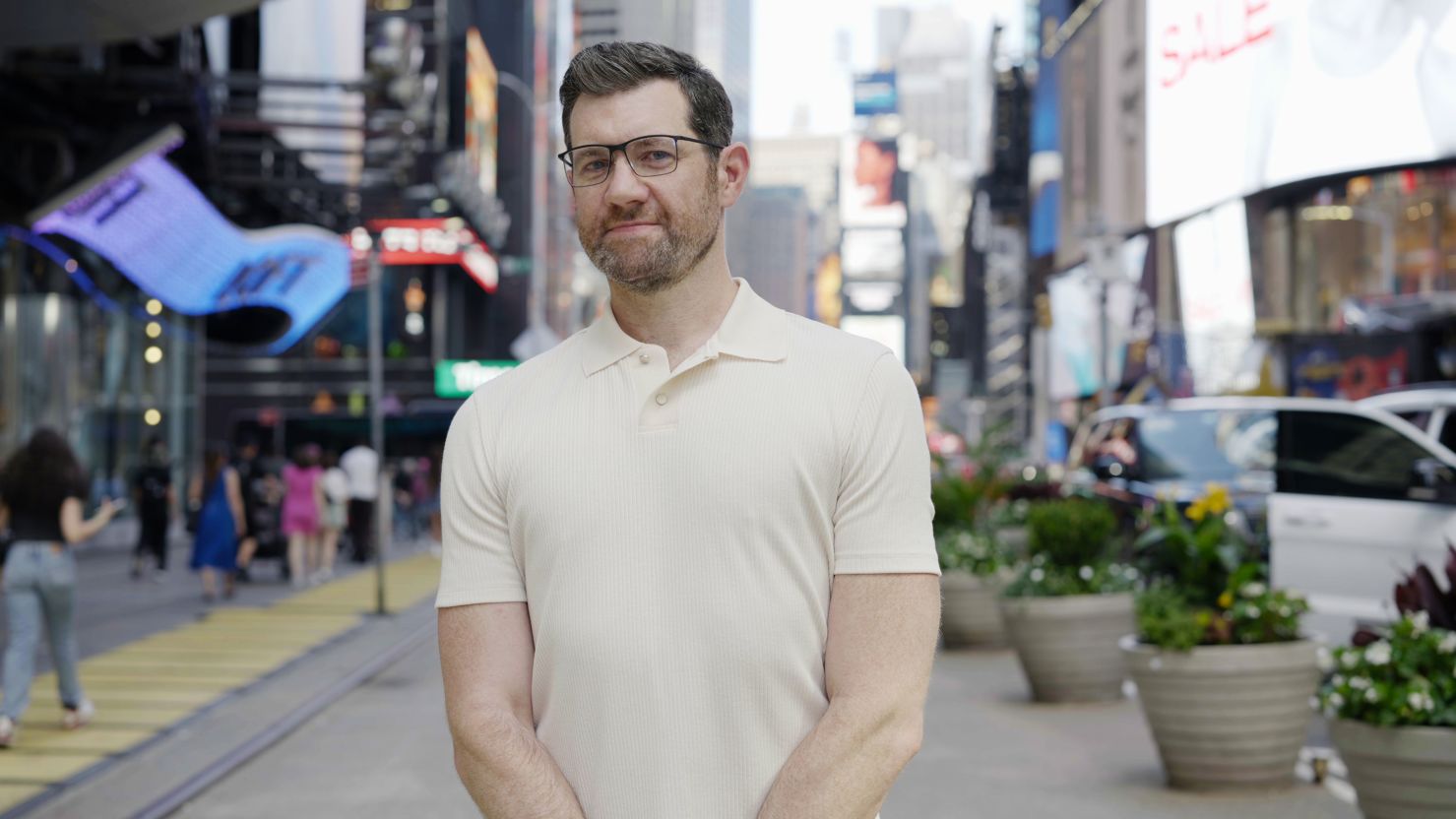
It’s a hot summer afternoon in Greenwich Village, and Billy Eichner is coming face-to-face with the nuisance he created.
To his right, a young man is shooting on his iPhone while his friend interviews a bemused passerby. Behind him, a woman is holding up a whiteboard and asking New Yorkers about their lives. These days, walking through the center of a major city means fielding interview requests from would-be influencers. And it might be this man’s fault.
“I’m so proud of what I’ve spawned,” Eichner jokes as he sidesteps one content creator. “Where’s my Mark Twain Award for American Comedy?”
Eichner became one of the internet’s most recognizable comedians after his breakout creation, “Billy on the Street,” became a sensation on TV, then on YouTube, and then again on TikTok. The show is an exaggeration of Eichner’s younger self: It features his overheated quizzing and yelling at New Yorkers about popular culture, often ending with him imploding in a ball of mock fury. And it has lived a thousand lives online, clipped and meme-ified to smithereens.
That wave of popularity helped Eichner land subsequent roles in “Parks and Recreation,” “American Horror Story” and as the voice of Timon on “The Lion King” movie reboot. But Eichner has a complicated relationship with the show that made him a star. He has become an actor trapped within the confines of his own invention, a tension he discusses candidly.
CNN interviewed Eichner, 47, on a recent New York afternoon. We walked the same streets that made him, meeting on Broadway and then taking a cab to Washington Square Park, the first place he shot “Billy on the Street.”
During the walk, he dodged content creators and influencers that Eichner’s show inspired – with several mobbing him as we went. One dubbed him “the Christopher Columbus of street interviews” while another conducted an interview with Eichner before suddenly realizing who he was. “Oh my god, Billy!” she screamed, loud enough to make Eichner jump.
He also discussed his history-making 2022 romantic comedy “Bros” – the first gay rom-com to be produced and distributed widely by a major studio, and the first to feature an entirely LGBTQ+ cast – as well as the heated online debate that followed its release.
And we talked about his new audiobook memoir, “Billy on Billy,” which is part life story and part attempt to redefine how the world sees him. “I wasn’t always Billy on the Steet,” he tells us. “This is a character – it’s not the real me.”
The questions and answers below have been edited for brevity and clarity.
CNN: Your career has been sculpted by New York. As a pop culture-obsessed kid growing up in Queens, what did it mean to you when you came into the city and saw the skyline?
Eichner: It was magical. I actually just got chills as you said that. It felt so romantic to make that drive across the 59th Street Bridge. Whenever I land at JFK or LaGuardia and I take that drive back into Manhattan, I still feel that way. New York is the center of everything, and there’s a certain electricity that you just don’t get anywhere else.
What is it about New Yorkers that made a show like “Billy on the Street” work?
I’ve always thought “Billy on the Street” is this twisted Valentine to New Yorkers, essentially. They’re my co-stars on the show. They’re honest, there’s a bluntness, there’s a nonchalance about celebrity. It’s not the easiest place to live. It’s chaotic, no one’s in a huge apartment – but you still choose to be here because you need the energy of the city.
In your audiobook, we hear you laugh and we hear you sing. But we also hear the emotion in your voice, especially when you talk about your mother.
Yes, my mother died when I was 20, completely out of the blue. Like a lot of young gay boys, I was very close with my mother. My mom loved gay men. These little conversations you have, things that might seem like they’re not very meaningful when you’re a kid, have really stuck with me.
My dad died a month before we sold “Billy on the Street” as a TV show. So yes, they missed (my success), and that is obviously sad and painful and something I think about. (But) I can feel how much they love me still, and feel how much they wanted me to succeed.
The reaction from parents who have been listening to the book has really touched me. They keep writing to me: ‘I want to be Jay and Debby (Eichner) for my kid.’ ‘I have a kid who’s into the arts, I have a creative kid, I have a gay kid, I have a trans kid.’ A lot of parents have an expectation or a dream for who their kid is going to be. You’re not necessarily going to get that kid. Your child is going to have their own interests. They might differ from yours. They might scare you. You might be a little uncomfortable with who they are at first, but it’s their life. It’s who they are.
When you were trying to break through in the early 2000s, there were not a lot of openly gay male comedians or actors.
I didn’t set out to be a comedian. I went to Northwestern — I was a theater major. Even people who thought I was talented in my 20s never knew where to put me. I didn’t comfortably fit into any one Hollywood category of actor. I wasn’t quite the leading man. I was gay, but I wasn’t a stereotypical, wacky gay neighbor.
Is being pigeonholed something you’ve had to fight against?
For sure. What often happens is if you have a persona people like (as with “Billy on the Street”), they want you to just keep doing that, or variations on that. I really have had to draw a line in the sand and say: ‘No. You wanted to be a theater actor, you were a serious actor in college, you were doing Chekhov and Shakespeare and “Angels in America.’’ I can’t really control what other people do. But I had to remind myself: Don’t stereotype yourself.
Did ‘Billy on the Street’ become a box that you felt you had to break out of?
Yes, but it’s a champagne problem … I’m proud of it. I created it. No one cast me on that show. I ended the show, but it’s only gotten more popular since, because the clips online haven’t stopped circulating for 15 years. That’s very rare, and I want to honor it.
Did it give people a very specific idea of who I am and what I do? Yes. Has that been limiting at times? Yes. But I had to break through some way. I broke through, and my whole process since then has been about telling the world, and also reminding myself, who I really am.
The show came about just before social media took over.
Compared to now — when social media gives everyone so much anxiety, and we’re all doom-scrolling, and (there is) an avalanche of content — it felt a little bit more quaint. A lot of people my age miss a monolithic culture. Social media is a double-edged sword. There are great things about it. There are horrible things about it. I don’t know if I would have a career without it, truthfully, because it democratized culture.
And nowadays, you have content creators clogging the streets of New York around you.
I know. I’m probably somewhat responsible for that!
The man-on-the street interview is its own subgenre on TikTok, and in a way, you’re the godfather of that brand of comedy.
I guess that’s true. That’s flattering. I certainly did not invent man-on-the-street. But I guess I reinvented it for the digital age, although I didn’t know I was doing that. It just happened by accident.
I also think what I do is a little different. I’m doing it in character. It was a satire. I think there was a very strong comedic point of view behind ‘Billy on the Street.’ It’s not just asking someone, ‘What are you wearing’ or ‘How much do you pay in rent?’ … It had more context and dimension to it which has gotten lost along the way. That’s the nature of the social media world that we live in.
Let’s talk about ‘Bros.’ What did that film do that other Hollywood movies didn’t?
I was trying to reflect adult gay male life in an honest way. A lot of stories about gay men, especially stories that connect with the masses, hinge on being in the closet. ‘Love, Simon,’ ‘Brokeback Mountain,’ even ‘Heated Rivalry’ – I love every project I just mentioned, and yet a lot of the storytelling hinges around characters who are struggling with being gay, (or) the act of telling the world, ‘I’m gay.’ That’s not my story, you know? And most gay men that I know – we’re not coming out anymore. We’ve been out a long time.
It connected with a lot of people, and it was well-reviewed. But at the box office, it didn’t have the effect you had hoped for.
There was no blueprint for how to sell a movie like ‘Bros.’ To do an R-rated gay rom-com and release it in 3,000 movie theaters, which is what Universal did, was very admirable, but also challenging. But I’m proud of it. I’m glad it played on all those screens, but what I cared most about was the movie itself.
The conversation online after the movie got a little heated, and you tweeted that straight audiences didn’t show up for ‘Bros.’ Do you regret that for some people, a social media frenzy overshadowed the movie?
I’m not really sure. We’re in this period where things come down to soundbites or tweets. ‘Bros’ was a complicated movie from the beginning, and you can’t really talk about it in a tweet.
But it’s kind of par for the course. People are going to have their hot take, and they’re entitled to have their hot take. For better or worse, I built my life online.
I think the movie, from a creative standpoint, has staying power. And I want to do things that have depth, that are more mature, that are more complex than ‘Billy on the Street.’ I love ‘Billy on The Street’ – that’s there to make people laugh, to give people a little bit of escape from their day. But I also want people to relate to other characters that I play that have more sophistication or dimension or emotional intelligence.
So, what’s next?
I moved back to New York (from Los Angeles) last year, and part of the reason is that I really want to get back to being a theater actor, which is what I set out to do when I was a kid going all those Broadway shows. That’s very important to me, that I get to have that experience. It could be Broadway or off-Broadway. I’m very focused on finding a play or musical to do in New York.
Video by Channon Hodge, Demetrius Pipkin, Jackson Loo, Rod Griola and Lila Dominus
Some information for this report was gathered via edition.cnn.com.
Community Credibility Vote
Help the community assess this article's credibility. Your vote is weighted by your trust score.
Related Articles
Sponsored
Sponsored