
She wanted one last epic trip after a devastating diagnosis. Being stuck for days in a pitch-black cave was not the plan
Michelle Cabrera’s body froze. The beam of the headlight she was following had vanished into the abyss. A disembodied voice yelled orders at her from the dark: “Go on, jump. You have to do it.”…
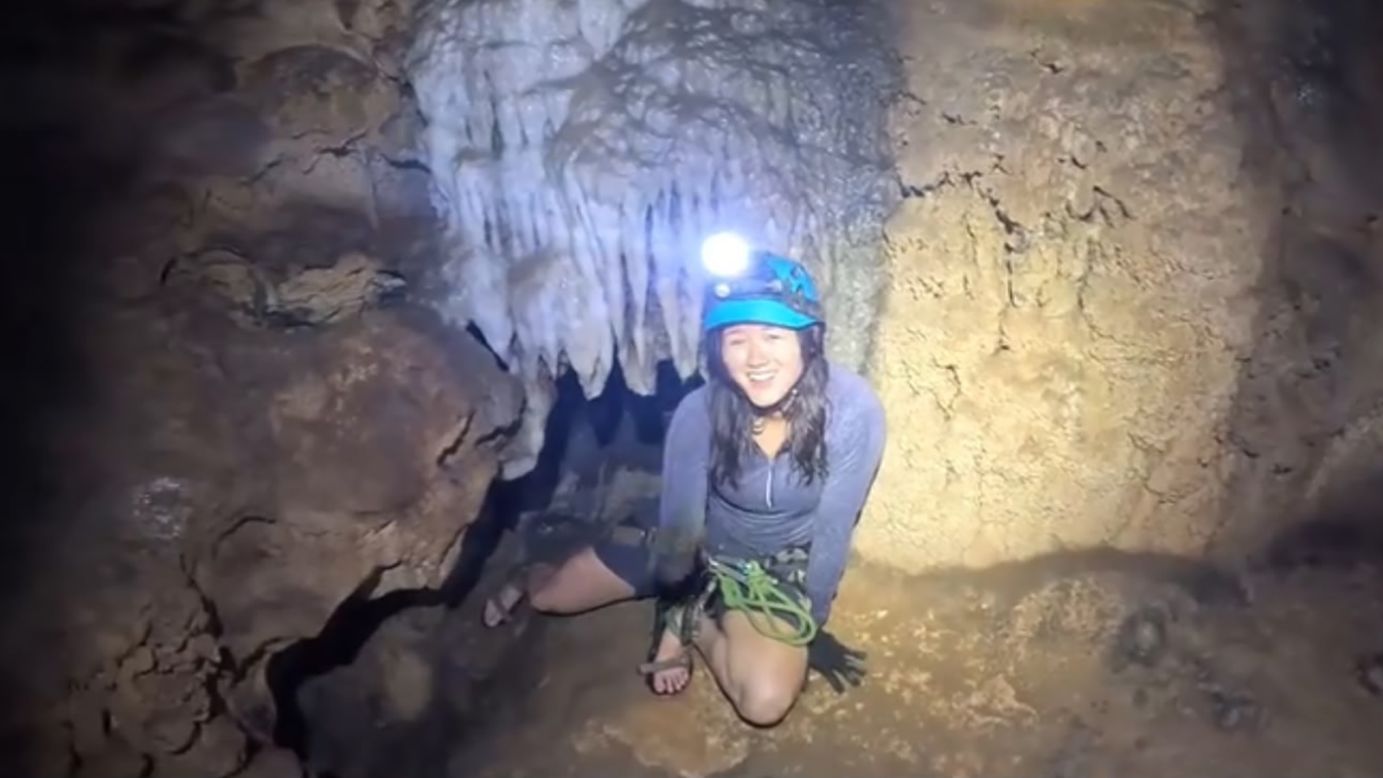
Michelle Cabrera’s body froze. The beam of the headlight she was following had vanished into the abyss. A disembodied voice yelled orders at her from the dark: “Go on, jump. You have to do it.”
Panicked, she looked around until her flickering headlight locked onto a small, ragged hole in the ground.
Taking a deep breath, Cabrera shuffled to the edge and saw water in the hole. She was momentarily relieved by the prospect of a soft landing.
But a second glance revealed jagged rocks lurking beneath the surface. And the drop wasn’t tiny — it looked like 25 feet down.
She started crying at the position she had put herself in.
“I just remember responding shakily that I couldn’t do it,” Cabrera tells CNN Travel. “The opening hole was so small that if I had jumped the wrong way and landed on one of the rocks, I might have died. I thought my time was up and kept thinking of my parents.”
This was Cabrera’s third day trekking in the depths of Ruc Mon cave on an expedition she originally thought would last just a few hours.
The large network of caverns in Vietnam’s Phong Nha-Ke Bang National Park is normally visited by organized day trips. But she’d sought out a more adventurous experience — and got way more than she’d bargained for.
Living in darkness
Raised in the suburbs of Chicago, wandering into nature wasn’t entirely foreign for Cabrera, who had been inspired by her father.
“My dad is adventurous and growing up we used to do a lot of nature-based trips like fishing in Wisconsin,” says Cabrera. “We watched Anthony Bourdain and Steve Irwin documentaries together and they, along with Indiana Jones, inspired me to travel.”
Her plans of going away came crashing down in 2023 when, at 19 years old, she says she was diagnosed with retinal thinning — a condition that drastically increases the risk of blindness.
“I suffer with severe myopia already, but I saw all of these sudden floaters in my vision and knew I had to get it checked out immediately.”
After a “tense” 30-minute eye examination, Cabrera says she was told that the risk of tears or retinal detachment caused by the retinal thinning, coupled with her already bad eyesight, meant her usable vision could be gone in a year. While retinal thinning doesn’t necessarily cause loss of vision, the complications can lead to blindness if untreated.
“I sat in my bedroom for hours and just sobbed and sobbed,” Cabrera adds. “I remember thinking I would rather be dead than go blind. I became depressed and thought, ‘What’s the point of living anymore if it’s in the dark?’ I felt horrible.”
Days later, while cleaning her room, she came across a journal she had written when she was 10. She discovered her younger self wanted to go around the world, particularly Asia. She couldn’t remember writing any of it, but she knew something had to change.
During her summer break from studying for a nursing degree, she booked a trip to Nepal, where she volunteered for three months, teaching English in a remote Himalayan village. The experience gave her a taste for travel and connecting with people, and on returning she decided she wanted to seek further adventures.
“As soon as I got off the plane, I thought to myself, ‘Why the heck should I start living when I retire?’ American culture is very much a nine-to-five lifestyle and then you retire and then travel after, but when you do, it’s only resorts. People kept telling me to focus on my studies, but in my heart, that wasn’t my path.”
Living under her parents’ roof, she worked odd jobs and saved up to go to Vietnam a year later, in 2024, vision still intact. The country drew her in, as her mother, who had moved to the US from the Philippines, is of Vietnamese and Chinese descent.
After three weeks traveling around the country, Cabrera headed to the remote, jungle-clad province of Quảng Trị, attracted by its isolation.
Going off-trail
Arriving at a homestay near Phong Nha-Kẻ Bàng National Park — famous for colossal caverns like Hang Sơn Đoòng — she immediately tried to get off the beaten path. She had no interest in the standard tourist experience.
Lacking any knowledge of the local language, she approached the homestay manager and, through a chaotic mix of enthusiastic hand gestures, broken English and sketches on scraps of paper, explained the kind of off-grid adventure she was craving.
“I asked her if she could set me up with locals so I could do an adventure in a cave for a day, and that I didn’t want a set route, just local knowledge. Two guys who were sitting at the table nearby overheard my conversation with her and asked if they could join in, to which I said yes.”
The trio of travelers was picked up in a van by three men from a nearby village two hours later.
“There was no setup. The locals took me in without any orientation or overview; it was a spur-of-the-moment ordeal.”
Neither party speaking the other’s language fluently, the driver struck up a broken conversation with Cabrera, asking her if she liked caving. When he reacted strangely to her saying it was her first time, she started to worry. “I wondered if then and there if the three of us had gotten ourselves into a sketchy situation.”
Typically, tours of caves in Vietnam’s national parks are regulated and can only conducted by licensed guides. It’s not clear if Cabrera’s guides were officially qualified.
They drove deep into the interior of the national park, passing through forested karst formations and jungle for two hours. When the van finally halted, they got out and hiked about an hour to a village where they were given food before a further 30-minute hike to the cave entrance.
It felt like the middle of nowhere. Looking around the dense foliage, Cabrera noticed there were absolutely no signs, no park rangers, and no paths — there didn’t seem to be any safety infrastructure.
Cabrera asked the driver if anyone had died in the cave. He reassured her she would be fine.
One of the guides, Ron, handed out rubber sandals to everyone, calling them “cave shoes.”
“He really wanted everyone to get going, but I was shocked,” Cabrera says. “There was barely any equipment. We got given a cheap headlamp that kept turning on and off, and they set up a rickety rope ladder for us so we could climb down from the mouth of the cave.”
Despite the concerns she shared with her fellow travelers, her sense of adventure won out. The three shared nervous laughter as they agreed to go ahead. At this point, she says, she expected the expedition would last a matter of hours and she was determined to face her fears.
And so, she put her foot down on the first rung. The ladder swung fiercely. She held on tightly as she made her way down.
“I was hanging on for dear life,” says Cabrera. “When I got to the bottom and looked up I realized we came down a long way. It felt like just us and the subterranean world.”
With a musty stench from bats and the damp cave in their mouths and nostrils, the six navigated their way down what seemed like an infinite network of pathways, some turning into shoulder-scrapingly tight spaces.
“There were massive centipedes inside, like the ones you see in documentaries. They were glowing blue and it hit me that this was all real.”
After several hours of subterranean trekking, Cabrera began to wonder when they would turn back around. When she asked, the guide’s response felt like a physical blow. The reality of the situation became grimly apparent.
“Ron laughs at me and says, ‘You think we can go back out this way? No, you can’t. We will be another couple of days.’”
Shocked, Cabrera looked at her two traveling companions in the dim beam of her headlamp. Their faces reflected her own sudden alarm. They were trapped, miles underground under millions of tons of rock. They had no extra clothes, no supplies and no one in the outside world knew where they were down here.
A heavy silence fell over the trio. No one knew what to do.
Slime mountain
Eventually, as night arrived in the already dark cave, the group set up camp. The mood lightened when the guides revealed they had packed tents into their waterproof bags. There was also water and food — chicken and rice wrapped in banana leaf.
“I had to eat that with bat poop-covered hands,” Cabrera says. There was another discomfort: She had no change of her daily disposable contact lenses, so ended up wearing them for three days.
Despite the anxiety of being unexpectedly stuck in the cave, Cabrera said she slept well, the exhaustion of the day catching up with her.
When trekking resumed the next morning, they came across what looked like a slime-covered underground mountain. To help her climb, the guides attached Cabrera to a rope and harness, which she says still didn’t feel safe.
But she persevered. Three hours later, when everyone had reached the top, Cabrera says she felt an overwhelming sense of relief that there would be no more climbing. There was, however, another nasty surprise waiting for her — a huge snake vertebra. The guides said in monsoon season the caves fill with water, which is how it probably got so high up.
“The thing is that we had swum through deep cave rivers earlier that day. If I had known there could have been snakes in there, I couldn’t have done it,” Cabrera says.
To make matters worse, she then had to descend the other side of the mountain they had just spent hours going up. Almost slipping halfway down left her in a state of panic.
“After that episode I had to become hyper-focused otherwise it could have gone badly.”
She made it down, then endured a subterranean river swim during which the team was swarmed by gnats. They ate another meal of chicken and rice in wet clothes, then bedded down for a second night.
The final push
The next day, Cabrera says they had to navigate “rock ledges the width of a foot” with crevices on either side. It was then that she found herself on the ledge, frozen with fear, with Ron at the bottom telling her to jump into the hole.
Being religious, Cabrera spoke to Jesus. This, she says, finally gave her the courage to make the jump and, despite not knowing how deep the water was or whether it contained snakes, she squeezed her eyes shut and jumped.
She splashed down safely and unscathed, but moments later found herself sucked down into a funnel system that felt like a dangerous water slide. “There I am getting zoomed into this river with rocks on either side. One of them slams into my chest, but I’m still getting pushed along, until it came to a stop,” she says.
After climbing out of the water and finding her fellow cave explorers, she struggled to process what had just happened. “I couldn’t speak for 10 minutes due to the adrenaline.”
But the end was in sight. Shortly afterward, they emerged from the cave, back into fresh air, where she recalls being astounded that she’d survived.
“I cried when I made it out alive.”
She walked out largely unscathed, save for bruising and a bout of food poisoning that would last the next three days.
Facing fears
It’s been two years since her trip to Vietnam and Cabrera’s eyesight thankfully remains intact — something she credits to her religious faith. Her optician says her problems remain and has reiterated the warning about potentially losing her vision from something as simple as a blow to the head.
But neither these warnings nor her cave ordeal has slowed her down or dimmed her taste for adventure.
More recently, she snapped a knee tendon while learning to surf in Australia and she got stuck in a landslide on her second trip to Nepal.
Having given up on her nursing studies, she’s now traveling through South America.
One of her inspirations for continuing to travel, she says, is her determination not to give in to fear — a lesson she learned in the darkness of the cave.
“I know it is different for women traveling as we are more prone to sexual violence, but at the same time, why would I make my decisions based on a fear?” Cabrera says.
Women should defy any “fear bubble” imposed by society’s expectations, she adds. “And that’s why I have gone on so many adventures, because I want to be that representation.”
Asked if she would go spelunking again, she smiles: “Maybe.”
Some information for this report was gathered via edition.cnn.com.
Community Credibility Vote
Help the community assess this article's credibility. Your vote is weighted by your trust score.
Related Articles
Sponsored
Sponsored